If your horse arena footing feels too deep, shifting, or loose under hoof, do not immediately buy more sand or dump additives onto the track. Deep footing is a physical condition caused by either excessive uncompacted sand depth, grain-shape instability (round sand grains rolling like ball bearings), moisture starvation, or improper arena groomer tine settings. Before adding materials, measure footing depth on a grid, evaluate moisture throughout the profile, and review sand particle shape.
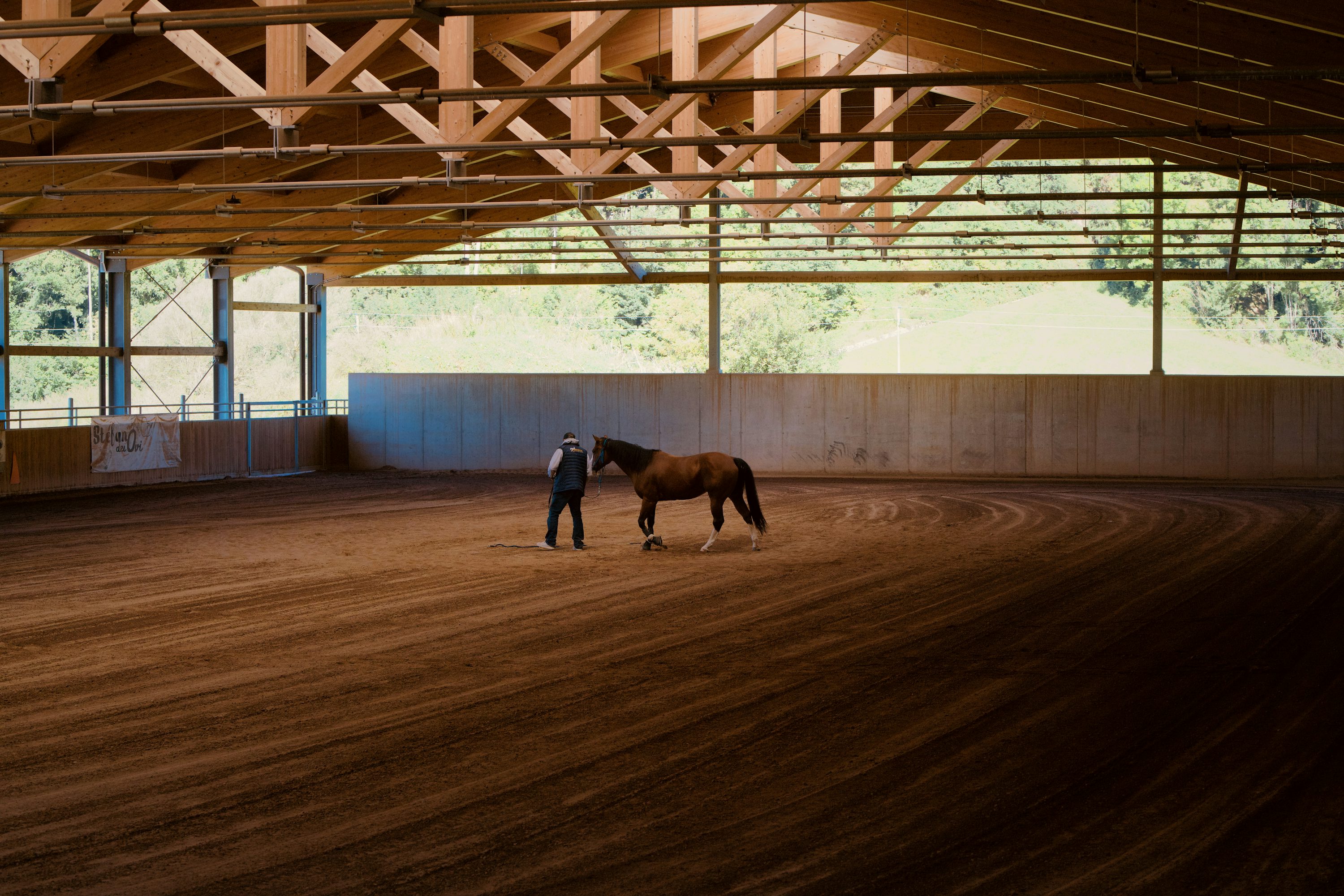
1. Start With a Measured Condition Grid, Not a Material Order
Riders and trainers often describe several distinct physical surface failures using the single word 'loose'. For example: a horse's hoof sinks excessively through uncompacted sand with no firm push-off point; sand rolls away laterally on tight turns; or footing has accumulated in a deep mound along the outside rail while the inside riding track is worn down toward the base.
Penn State Extension notes that sand surfaces typically begin around 50 mm (2 inches) and can be adjusted gradually, cautioning that excessively deep uncompacted sand increases tendon strain. University of Kentucky guidance confirms that loose working depth should be managed based on discipline and maintenance. The first engineering step is to map your actual depth across the arena.
| Observed Footing Symptom | Plausible Root Condition | Immediate Diagnostic Check | Action to Avoid |
|---|---|---|---|
| Footing feels deep and heavy across the arena | Sand depth exceeds required profile, or sand consists of uniform round particles that cannot interlock | Measure depth to compacted base across a grid; request a sieve test for particle shape | Do not add more sand or loose material before verifying depth and gradation. |
| Deep and loose only at the rail, corners, or jump lines | Traffic has displaced footing laterally toward perimeter kick-boards | Compare depth along rail vs. quarter-lines; inspect groomer side-scraper settings | Do not treat local displacement as proof that all sand must be replaced. |
| Footing is loose, shifting, and produces heavy airborne dust | Moisture starvation: dry sand grains lose capillary cohesion | Check water penetration below the top crust; verify irrigation coverage | Do not drag powder-dry sand without prior irrigation. |
| Uneven ridges and hard spots after dragging | Groomer tines set unevenly, or tines are dragging into the base | Inspect groomer levelness, tine wear, and check for base stone intrusion | Do not lower tines deeper without verifying base clearance. |
2. Operational Diagnosis: A Five-Point Depth & Moisture Survey
Before deciding whether to add synthetic fibers or remove excess sand, perform a field audit using a graduated probe and an arena inspection log:
Illustrative Field Measurement Case Study (For Reference)
An arena operator reported that horses were struggling in deep sand. A 5-point probe test revealed:
• Center Line: 65 mm depth (firm, damp, stable)
• Quarter Lines: 75 mm depth (good traction)
• Rail Line (Track): 45 mm depth (firmly compacted, thin)
• Rail Perimeter (against kick-board): 140 mm depth (deep, uncompacted berm)

Diagnosis: Circling traffic had displaced footing to the fence, which routine dragging failed to retrieve. The operational solution: an angled side grader pulled the berm back onto the track, followed by watering and roller compaction. No material purchase was required.
3. When Synthetic Fibers Provide the Appropriate Solution
If your depth measurements confirm an even profile over a sound base, but the surface remains loose and unstable, the root cause is often sand grain shape. In natural river sand or wind-blown sand, spherical particles roll against one another without shear resistance.
This is where engineered additives can assist. Adding Polyester Arena Fiber creates a 3D tensile root structure that bridges between sand grains, helping convert a rolling surface into a secure footing. Alternatively, adding Polyester Textile Flakes introduces micro-cushions that retain water in dry indoor facilities.
Recommended Materials & Technical Guides
Questions Answered in This Article
How deep should horse arena footing sand typically be?
Loose working depth is commonly managed between 60 mm and 100 mm depending on discipline, sand characteristics, and horse use. Depths exceeding 120 mm are generally considered heavy by footing specialists.
Can adding fiber fix an arena that has excessive sand depth?
No. If sand depth is already excessive, adding fiber will create a thick, heavy surface. Excess sand should be leveled or removed to establish the desired profile before incorporating fibers.
Why does footing accumulate along the rail?
Centrifugal force from horses circling pushes footing outward. Regular dragging with an angled arena grader equipped with a wall-wheel helps pull bermed footing back toward the center line.